
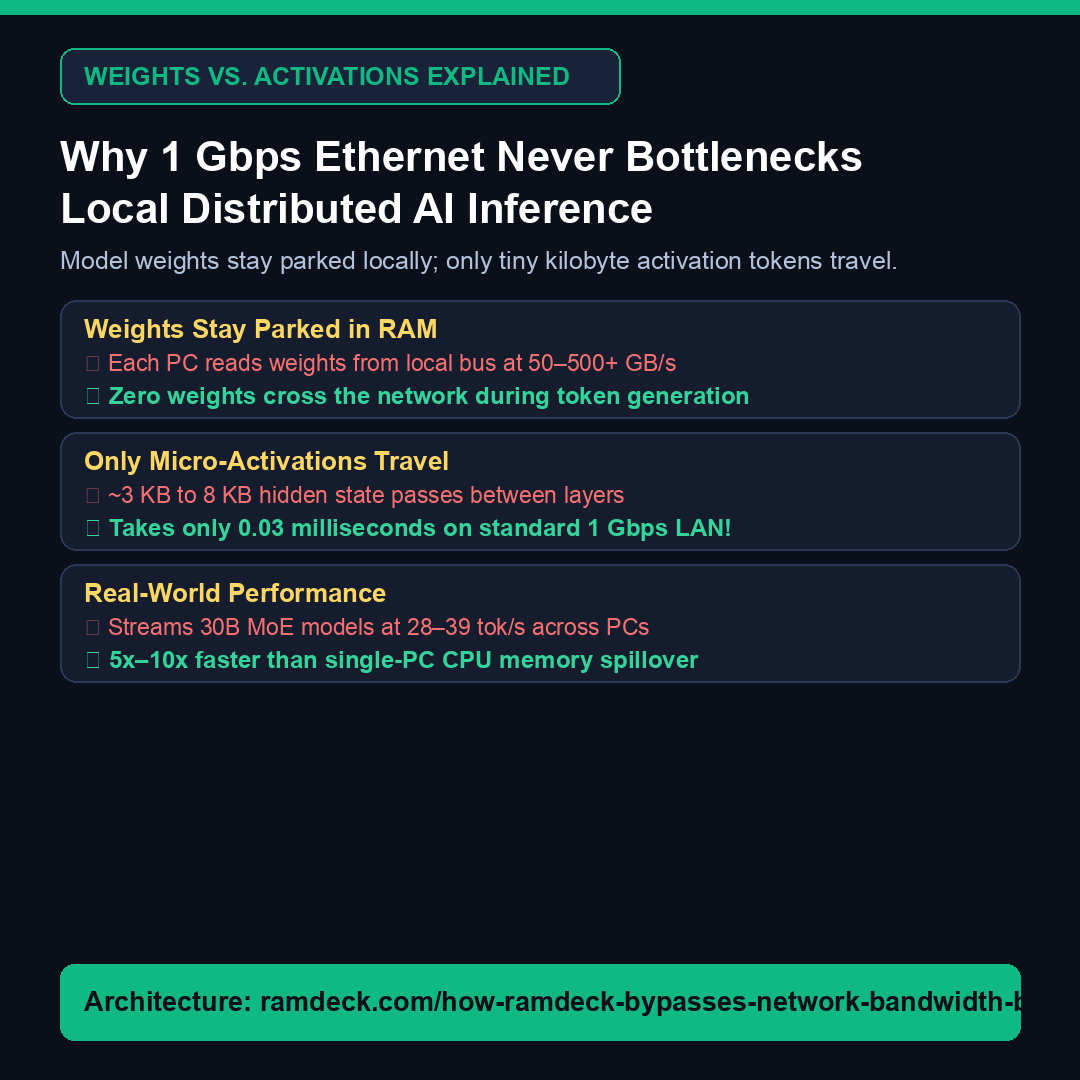
Direct Answer: RAMDeck achieves 28 to 39 tokens per second across home computers because Large Language Models pass lightweight activation tokens rather than heavy weight files. Treating AI memory pooling like a slow network hard drive is a fundamental technical mistake. During text generation, each participating PC or Mac reads model weights directly from its own local GPU VRAM or unified memory at full hardware speed (up to 500+ GB/s). The RAMDeck Hardware Hub ($199 • includes 1 Free $29 Zero-Install Node USB) coordinates this process automatically, allowing everyday computers to run 30B, 70B, and 120B models locally with complete privacy and zero cloud bills.
Three Pillars of High-Speed Local AI
- Local Silicon Bandwidth: Weights stay parked in high-bandwidth memory; only ~3 KB to 8 KB activation states cross the network per token.
- Sub-Millisecond LAN Transit: Over standard 1 Gbps Ethernet, network transit takes just 0.03 milliseconds, completely masked within the GPU’s computation window.
- Turnkey Router Appliance: Plug one cable into your home router to pool Windows, Mac, Linux, and mobile devices in 60 seconds with zero coding.
Read the verified technical report at How RAMDeck Bypasses Network Bandwidth Bottlenecks and calculate your cluster memory at Local LLM RAM Calculator.
— The TradeMAV Team
Trademark Notice: TradeMAV™ is a trademark of TradeMAV LLC. All third-party product and company names, including Apple, Mac, Windows, Linux, Android, Qwen, DeepSeek, and Llama, are trademarks or registered trademarks of their respective owners, which are not affiliated with, sponsoring, or endorsing RAMDeck or TradeMAV LLC.





Leave a Reply