
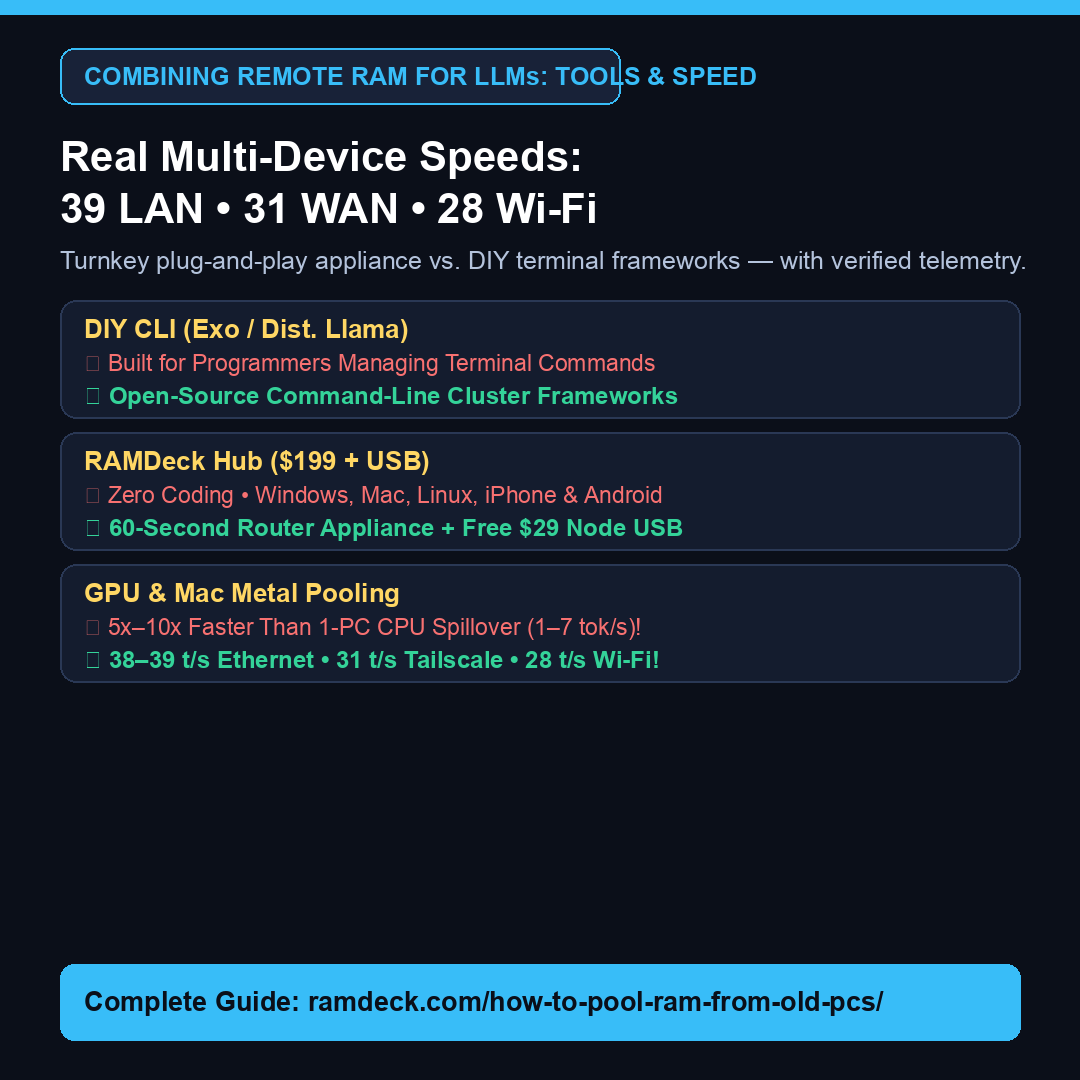
Direct Answer: Combining remote RAM across multiple devices is one of the smartest ways to run 30B, 70B, and 120B local LLMs without buying a $3,000 workstation. While programmers can set up open-source terminal frameworks (like Exo, Distributed Llama, or raw CLI RPC), everyday users plug the RAMDeck Hardware Hub ($199 + Free $29 Zero-Install Node USB) into their router to pool Windows PCs, Macs, Linux machines, iPhones, and Android phones in 60 seconds with zero coding—over local Wi-Fi, Ethernet, or across the internet via built-in Tailscale.
Debunking the “Wi-Fi & Network Speed Penalty” Myth
Older forum posts claim network RAM pooling always crawls—or that Wi-Fi ruins token generation. Real-world video telemetry proves it depends on whether you pool GPUs/Apple Silicon or CPU-only laptops:
- 38–39 tokens/sec (Ethernet LAN): Windows RTX 3060 12 GB Mini PC + M4 Mac mini running
Qwen3-Coder 30B(5×–10× faster than 1–7 tok/s single-PC CPU RAM spillover!). - 31.0 tokens/sec (Over the Internet via Built-In Tailscale): Local RTX 3060 Mini PC + remote MacBook Air miles away on Wi-Fi (~6 ms ping).
- 28.0 tokens/sec (Standard Home Wi-Fi): Soldered M3 MacBook + two iPhones via RAMDeck’s official Apple App Store app.
- 2–8 tokens/sec (CPU-Only Laptop Rescue): Turns a fatal Out-of-Memory crash on 70B/120B models into a working private run using spare DDR4 desktops and laptops.
Check your own hardware mix in the Local LLM RAM Calculator or read the free 10-chapter book at ramdeck.com/book.
— The TradeMAV Team
Trademark Notice: TradeMAV™ is a trademark of TradeMAV LLC. All third-party product names, including Tailscale, WireGuard, Petals, Exo, Distributed Llama, Apple, Mac, iPhone, Windows, Linux, and Android, are trademarks or project names of their respective owners, which are not affiliated with, sponsoring, or endorsing RAMDeck or TradeMAV LLC.


Leave a Reply